
By Supply Chain Intel | Practical warehouse, inventory, logistics, and supply chain insights
Introduction: Inventory Accuracy Is Operational Integrity
Inventory accuracy is far more than a simple warehouse metric. It reflects the operational credibility of the entire supply chain. When the inventory shown in the system does not match what is physically available on the floor, the impact spreads quickly across the business. Pickers waste time searching for stock that is not there, orders are delayed or shipped short, and customers lose confidence. Downstream, procurement teams place extra orders to protect service levels, finance struggles with reconciliations, and supervisors spend too much time solving avoidable issues instead of leading improvements.
Many operations believe they have an inventory problem. In reality, they often have a process discipline problem. High accuracy does not come from counting more often alone. It comes from strong warehouse operations, disciplined scanning, controlled movements, and a reliable cycle count process. This guide explains how to build that foundation using Standard Work, Cycle Counting, and Root Cause Analysis.

Key Takeaways
- Inventory accuracy is not only about counting. It is about process control.
- Most inventory errors start in receiving, putaway, picking, labeling, or damaged goods handling.
- A structured cycle counting program is more effective than relying only on annual physical inventory.
- Root cause analysis helps prevent the same discrepancy from happening again.
📑 In This Article
What Inventory Accuracy Really Means
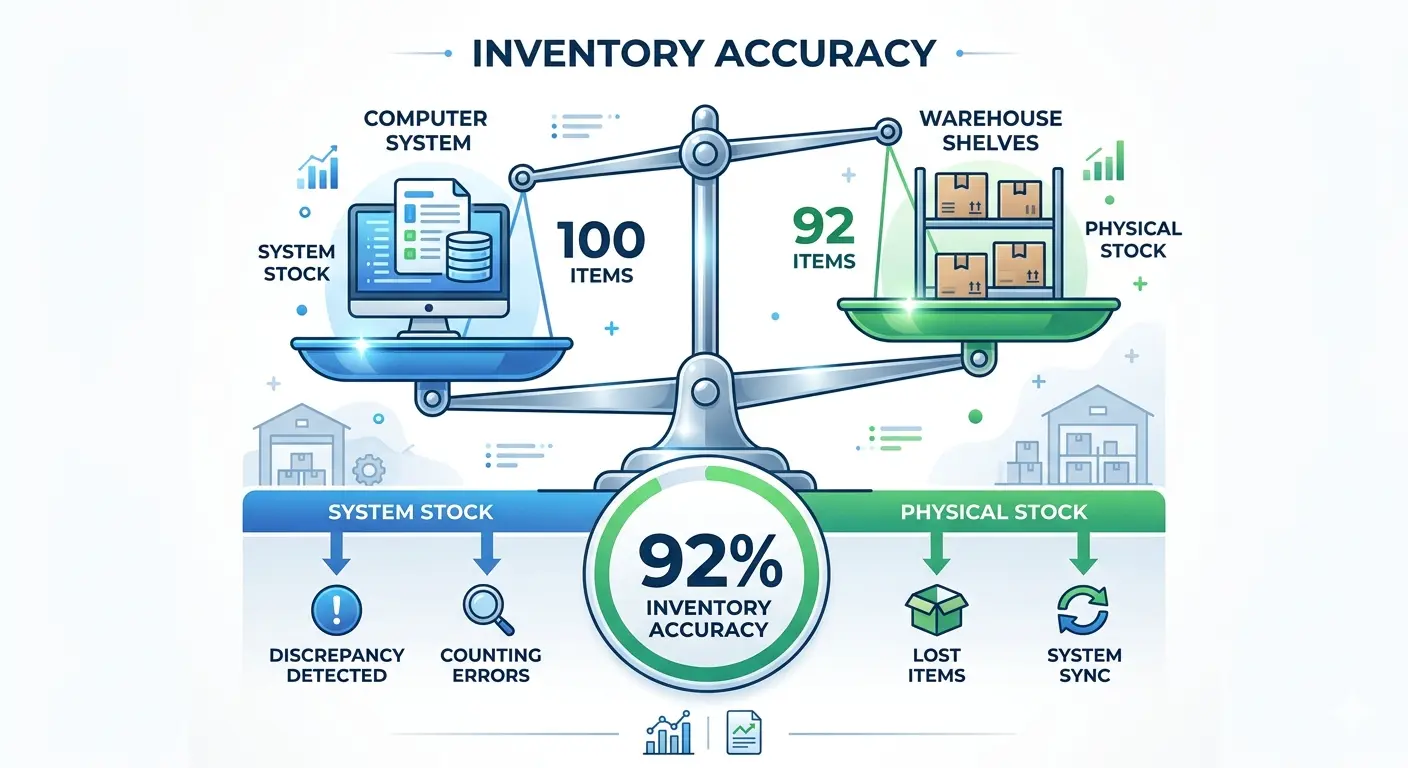
At its core, inventory accuracy measures how closely your system inventory matches your physical stock. The formula may look simple, but in real warehouse environments, accuracy has several layers. A location may show the right quantity in the system, but if the wrong SKU is in the bin, the operation still fails. In the same way, if damaged items remain mixed with sellable items, the system may still look correct on paper while the business faces service issues in reality.
In a high-performing warehouse, true accuracy includes:
- Quantity Accuracy: System on-hand levels match physical on-hand levels.
- Location Accuracy: The right SKU is stored in the correct location.
- Identity Accuracy: Barcodes, units of measure, and pack sizes are correct and clearly labeled.
- Condition Accuracy: Damaged, expired, returned, or non-sellable items are separated and correctly recorded.
That is why inventory accuracy connects closely with compliance and quality. A system is only reliable when both the process and the physical result are correct.
Why Inventory Accuracy Matters
Inventory accuracy affects much more than stock records. It directly impacts service, labor, cost, and trust. When inventory is inaccurate, teams lose time, work around system problems, and create even more errors by making rushed decisions.
Here is why it matters in day-to-day operations:
- Order fulfillment improves: Pickers can find items faster and orders ship more accurately.
- Labor productivity improves: Less time is wasted on searching, recounting, and investigating avoidable discrepancies.
- Procurement decisions improve: Teams order based on real demand instead of false shortages.
- Customer trust improves: Accurate stock supports on-time, in-full fulfillment.
- Financial control improves: Inventory values, shrink, and reconciliations become more reliable.
In short, inventory accuracy is one of the strongest foundations of operational stability.
Why Warehouses Lose Accuracy: The 8 Common Root Causes
Inventory discrepancies are rarely random. They usually come from small process failures that repeat over time. Understanding those failures is the first step toward stronger inventory control and better warehouse process discipline.
- Receiving Errors: Wrong counts at the dock, wrong unit of measure, or incomplete paperwork at receiving.
- Putaway or Stowing Mistakes: Items placed in the wrong location or different SKUs mixed in one bin.
- Labeling Issues: Damaged, unclear, or duplicate barcodes that lead to scanning failures and wrong storage decisions.
- Transaction Timing Gaps: Physical movement happens first, but the system is updated later or not updated at all.
- Picking Exceptions: Partial picks, substitutions, and manual workarounds are not recorded properly.
- Unrecorded Damage: Damaged items stay in active inventory instead of being adjusted and moved to the proper zone.
- Poor Returns Handling: Returned units go back to stock without proper checks or under the wrong SKU.
- Slotting and Replenishment Issues: Overfilled bins, replenishment mistakes, or replenishment completed without system confirmation.

Building a Structured Cycle Counting Program
Annual physical inventory alone is not enough for modern warehouse operations. By the time a full count happens, many errors have already affected service, planning, and labor. A structured cycle count program is far more effective because it checks inventory continuously and helps teams react faster.
ABC Analysis: The Foundation of Frequency
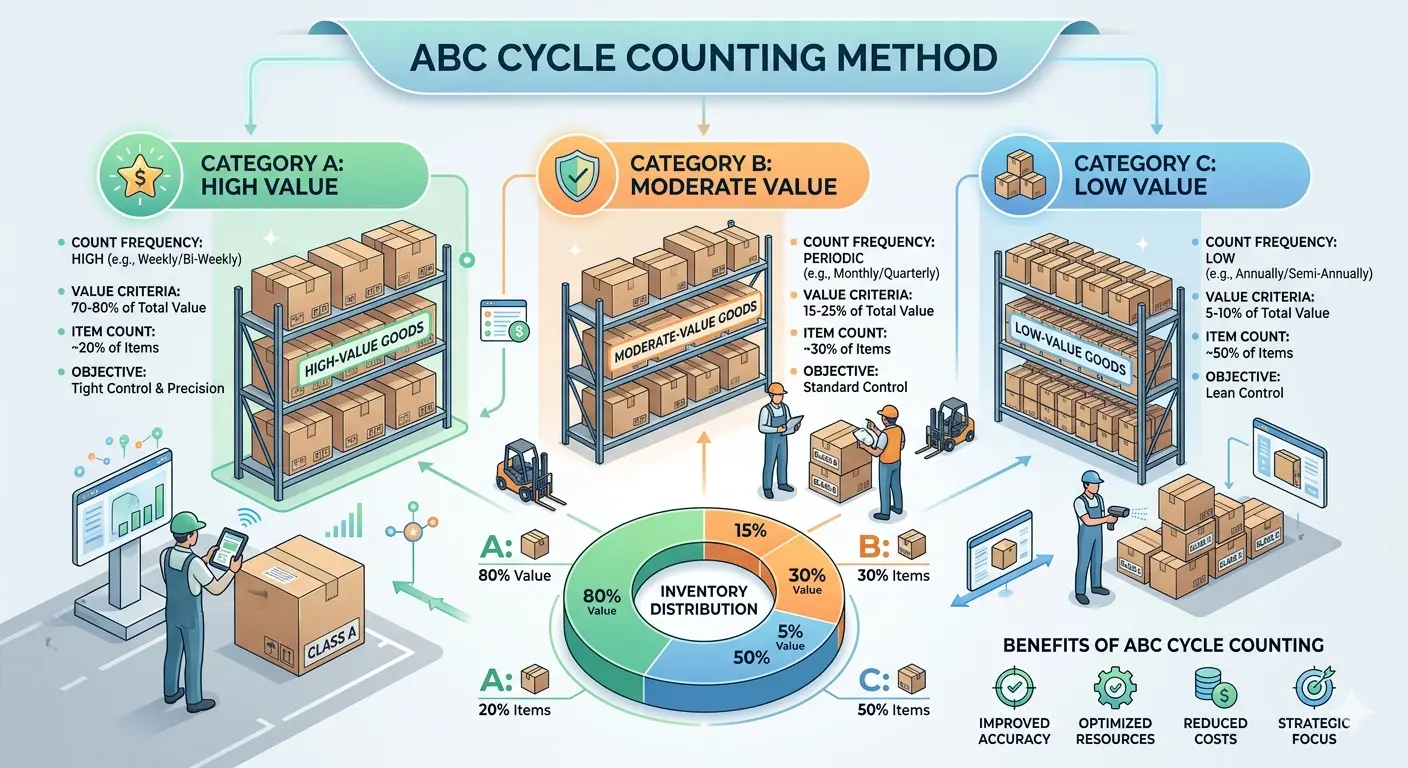
Not all SKUs carry the same operational risk. Some items move every day and have major service impact. Others move slowly and create less exposure. That is why strong programs use ABC Analysis to decide counting frequency.
| Class | Example Criteria | Count Frequency |
|---|---|---|
| A Items | High Value / High Velocity | Weekly |
| B Items | Moderate Movement/Risk | Monthly |
| C Items | Low Movement / Low Risk | Quarterly |
Execution Rules and Cut-off Discipline
A cycle count is only useful when the count reflects a controlled snapshot of reality. If product is moving during the count, results become unreliable. That is why cut-off discipline is essential.
- Freeze by Location: No movement in or out of the target bin while counting is in progress.
- Cut-off Times: All transactions for the target locations should be completed before the count begins.
- Recount Thresholds: Clear rules should define when a second count is required, especially for A-items or large variances.
A disciplined cycle count program not only detects errors but also helps build better accountability across the operation.
Root Cause Analysis: Stop Adjusting, Start Correcting
Adjusting inventory without investigating the reason behind the discrepancy is one of the biggest mistakes in warehouse control. It may clean up the system for the moment, but the same issue will come back again. Root cause analysis turns a reactive operation into a controlled one.
The 5-Why Method
When a discrepancy is found, the 5-Why method helps you move from the symptom to the real process failure.
- Problem: Location shows -5 units.
- Why? Picker could not find the item.
- Why? The item was placed in the wrong bin.
- Why? The stower misread the bin label.
- Why? Label clarity was poor.
- Why? The layout changed, but labels were never updated. The real fix is not only a stock adjustment. It is a process correction to update labeling standards and sustain them.
Controlled Reconciliation Workflow
Every warehouse should have a documented stock reconciliation workflow so that discrepancies are handled consistently.
- Counter detects a mismatch.
- Supervisor performs physical verification.
- Movement history, receiving records, and recent picks are reviewed.
- The root cause is identified and recorded.
- A controlled adjustment is made and the corrective action is assigned.
Warehouse KPIs that Matter
Strong inventory control requires strong measurement. Leaders should focus on the few warehouse KPIs and dashboards that drive the right actions.
- Inventory Accuracy %: (Accurate Locations / Total Locations Counted) x 100.
- Cycle Count Compliance %: (Counts Completed / Counts Scheduled) x 100.
- Variance Rate: (Total Variance Units / Total Units Counted) x 100.
- Shrink %: (Total Adjustment Value / Total Inventory Value) x 100.
- Repeat Error Rate: How often the same SKU or location fails again.
Operational Controls and Standard Work
Technology helps, but it does not replace discipline. Inventory accuracy improves when standard work is followed consistently across receiving, stowing, picking, damages, and returns.
- Single SKU per Bin: Reduces mix-picks and stowing mistakes.
- Mandatory Scan Discipline: Every movement should be scanned at the point of execution.
- No Manual Overrides: Approval should be required to bypass system prompts.
- Dedicated Damage Zone: Prevents damaged stock from staying in sellable inventory.
Leadership and the 30-Day Action Plan
Inventory accuracy is not owned by one person or one department. It is a leadership discipline that depends on daily follow-up, coaching, and clear accountability.
Weekly Playbook for Supervisors
- Daily: Fix label issues immediately and clear exception bins such as damages and returns.
- Weekly: Run the ABC cycle count plan, review top variances, and assign corrective actions.
- Monthly: Review trends, clean up chronic mixed-bin issues, and adjust count frequencies if needed.
30-Day Implementation Plan
- Week 1: Review variance data, classify SKUs using ABC Analysis, and audit labels and locations.
- Week 2: Launch the cycle count structure and train teams on root cause logging.
- Week 3: Introduce a variance dashboard and audit scanning discipline.
- Week 4: Review trends, reinforce accountability, and adjust controls where needed.
Conclusion
Inventory accuracy is about control, not just counting. A warehouse that combines disciplined scanning, structured cycle counting, and strong root cause analysis will always outperform one that relies on large corrections after the fact. High-performing operations aim for 99%+ accuracy, but that result only comes through consistent process discipline and operational leadership.
Resources
Below is a sample ABC classification structure and cycle count log format that can help teams organize counting frequency, variance tracking, and management follow-up.
ABC Classification Spreadsheet / Daily Cycle Count Log
Sheet 1: ABC Classification & SKU Strategy
This sheet acts as the planning layer of your inventory control system. It helps determine how often items should be counted based on movement, value, and operational risk.
| Column Header | Purpose |
|---|---|
| SKU / Item ID | Unique identifier for the product. |
| Description | Basic name of the item. |
| Category | Category of the item. |
| Unit Cost | Used to calculate the financial impact of shrink. |
| Monthly Movement | Total units shipped. Helps identify high-risk items. |
| ABC Class | A, B, or C classification based on value and velocity. |
| Count Frequency | Weekly for A, Monthly for B, Quarterly for C. |
| Last Count Date | Ensures no SKU is missed in the cycle. |
| Next Count Date | Planned next count date based on count frequency. |
Sheet 2: Cycle Count Log
This is the execution sheet used by floor associates and supervisors to compare physical findings against system data.
| Column Header | Entry Type |
|---|---|
| Date / Time | When the count was performed. |
| Location ID | The specific bin or rack being audited. |
| SKU / Item ID | Unique identifier for the product. |
| Description | Basic name of the item. |
| System Qty | The on-hand quantity currently shown in your WMS. |
| Physical Qty | The actual count found by the associate. |
| Variance | Formula: Physical Qty - System Qty. |
| Variance % | Formula: Variance / System Qty. |
| Variance Type | Match / Short / Over. |
| Root Cause | Drop-down such as Receiving, Picking, Stowing, Damage, etc. |
| Corrective Action | Required follow-up based on the root cause. |
| Owner | Person responsible for the corrective action. |
| Date | Required completion date for the action. |
| Status | Open / Closed / In Progress. |
| Recount? (Y/N) | Triggered if variance exceeds set thresholds. |
Sheet 3: Top 10 Variance for Management
These top 10 variances can be pulled automatically from the Count Log sheet using the following Excel formula:
TAKE(SORTBY(CountLog!A3:P19, ABS(CountLog!I3:I19),-1),D2+1)
Sheet 4: Inventory Cycle Count Dashboard for Management
It provides an inventory accuracy snapshot along with key root causes of variance and ABC classification insights.
Download the sample Excel Sheet on Inventory Cycle Count. Make the necessary changes based on your organization, product type, and inventory structure.
Pro Tip
In well-designed cycle count systems, ABC class, count frequency, and next count date are automatically generated in the tracking sheet. This reduces manual errors and makes sure no SKU is skipped in the rotation.
Inventory Accuracy Operational Checklist
This checklist is designed to support inventory control, strengthen standard work, and improve counting discipline before, during, and after the count process.
Phase 1: Pre-Count Controls (Preparation)
- Verify cut-off times: make sure receiving and shipping transactions for the target locations are closed in the system.
- Freeze locations: physically or systematically lock the bins to prevent movement during the count.
- Check label integrity: confirm all bins have clear, scannable labels and no duplicate barcodes.
- Organize bins: ensure there is only a single SKU per bin and items are not mixed or hidden.
Phase 2: During-Count Execution (Discipline)
- Blind counting: perform the count without looking at the system quantity first to avoid bias.
- Unit of measure check: verify whether the count is in eaches, cases, or pallets.
- Identify damages: separate damaged or expired stock and move it to the dedicated damage zone.
- Scan every item: follow mandatory scan discipline and avoid manual overrides without approval.
Phase 3: Post-Count & Reconciliation (Root Cause)
- Immediate recount: if the variance exceeds the threshold, perform a second count immediately.
- Investigate history: review recent picks, pack activity, replenishment, and receiving records.
- Apply root cause analysis: use the 5-Why method to determine why the discrepancy happened.
- Log and adjust: record the adjustment and the root cause category for future trend analysis.
Phase 4: Management Audit (Daily/Weekly)
- Review variance dashboard: check the top variance SKUs and locations during daily stand-up meetings.
- Coach associates: provide refresher training for repeated errors or weak process discipline.
- Audit scanning compliance: observe stowing and picking to make sure standard work is followed.
5-Why Analysis Template: Inventory Discrepancy Investigation
This template helps teams move beyond simple stock adjustment and identify the real process breakdown behind the variance.
Investigation Overview
- Date of Investigation: ____________________
- SKU / Location: ____________________
- Initial Discrepancy: ____________________
- Assigned Investigator: ____________________
The 5-Why Analysis Path
Goal: Stop at the point where a process change can prevent recurrence.
- Direct Problem: Why was there a mismatch at this location?
- Example: The picker could not find the required units.
- Why? Why was the stock missing or in the wrong place?
- Example: The item was stowed in the neighboring bin by mistake.
- Why? Why did the stower place it in the wrong bin?
- Example: The stower misread the bin label during putaway.
- Why? Why was the label misread or the scan bypassed?
- Example: The labels were too small, faded, or unclear in that area.
- Why? (Root Cause): Why did the labels reach this condition?
- Example: The layout changed months ago, but the labeling standard was never updated to match the new rack density.
Corrective Action Plan
- Immediate Fix: Perform a full count of the affected zone and correct the stock position.
- Process Correction: Upgrade bin labels to high-visibility standards.
- Standard Work Update: Add a mandatory label audit to the relevant SOP.
- Owner: ____________________ Deadline: ____________________
Verification (7 Days Later)
- Has the error repeated? [ ] Yes [ ] No
- Is scanning discipline being followed in this zone? [ ] Yes [ ] No
Frequently Asked Questions
1. What is a good inventory accuracy percentage?
Most high-performing warehouses operate above 98% accuracy. Best-in-class operations aim for 99%+ with strong controls and consistent execution.
2. How often should cycle counting be done?
Fast-moving and high-value SKUs should usually be counted weekly. Moderate-risk SKUs can be counted monthly, while slower-moving items may be counted quarterly.
3. What causes recurring inventory discrepancies?
The most common causes are picking errors, mis-stowing, receiving inaccuracies, poor labeling, returns issues, and weak scanning discipline.
4. Is cycle counting better than annual physical inventory?
Yes. Cycle counting supports real-time control, detects issues earlier, and reduces the need for large year-end corrections.
5. How do you reduce repeat inventory errors?
Track root causes, enforce scanning discipline, improve labeling, audit high-variance areas, and use a structured reconciliation workflow.