
By Supply Chain Intel | Practical warehouse, inventory, logistics, and supply chain insights
Audit Readiness in Warehousing: The Complete Checklist Guide
Everything your team needs to stay compliant, organized, and ready — whether the auditor calls ahead or just shows up at the dock door.
Picture this: It's a Tuesday morning at a mid-sized distribution center in Ohio. The operations manager gets a call at 8:02 AM. An OSHA compliance officer is in the parking lot, requesting immediate access for an unannounced inspection. The manager feels a knot in their stomach — not because they've done anything wrong, but because they haven't done a systematic audit prep in over six months.
Sound familiar? This is the reality for thousands of warehouse managers across the country. Audits — whether from OSHA, the FDA, a third-party logistics client, or an internal compliance team — don't wait for you to be ready. But with a proper warehouse audit checklist and a culture of ongoing preparedness, you can walk into any inspection with confidence.
This guide walks you through exactly what audit readiness means in the real world, the categories your compliance warehouse program must cover, and how to use a structured checklist as your everyday operational backbone — not just a once-a-year panic tool.
You can explore more practical insights in our blog or browse related topics under Warehouse Operations and Compliance & Quality.

Why it matters
What does "audit readiness" actually mean?
Audit readiness isn't about passing a test — it's about running your warehouse the right way, every single day, so that an audit is just a formality. Think of it like this: a compliant warehouse doesn't scramble when auditors arrive. They just unlock the door.
In practice, audit readiness means your inventory records match your physical stock, your safety documentation is current, your equipment is maintained, your staff knows their procedures, and everything is traceable. In short — no surprises. Strong inventory accuracy and process discipline are at the center of this approach.
70%
of warehouses face at least one audit per year
$15K+
average OSHA fine for serious violations
3×
more likely to pass audits with regular prep cycles
48 hrs
typical notice window for supplier audits
Types of audits
Know your audit landscape
Not all audits are the same. Your warehouse audit preparation strategy should account for each type your facility is likely to face.
Regulatory audits (OSHA, FDA, EPA)
These are conducted by government agencies and focus on safety, environmental compliance, and in some industries (like food, pharma, or chemicals), product handling standards. Penalties for violations can be significant — and some result in temporary facility shutdowns.
Client and third-party logistics (3PL) audits
If you're operating as a 3PL or handling goods for major retail clients, expect periodic supplier audits. Companies like Walmart, Amazon, and large CPG brands have their own compliance standards and will audit fulfillment partners annually or bi-annually.
ISO and quality management audits
Warehouses seeking ISO 9001 certification — or maintaining it — undergo structured quality audits. These focus heavily on documentation, process consistency, and continuous improvement records.
Internal audits
These are your secret weapon. A rigorous internal audit program, conducted quarterly or monthly, catches issues before an external auditor does. Think of it as a dress rehearsal.
Real-world example
A beverage distribution company in Texas started running monthly internal audits after failing a surprise retailer inspection in 2021. Within 18 months, they passed two unannounced client audits with zero corrective action items — simply because their team had made compliance a daily habit, not a crisis response.

Core checklist categories
The 8 pillars of warehouse audit preparation
A comprehensive warehouse audit checklist covers far more than just inventory counts. Here are the eight core areas every compliance warehouse program needs to address.
1. Inventory accuracy and records
This is usually the first thing auditors want to see. Your physical stock count must reconcile with what your WMS (Warehouse Management System) or ERP shows. Discrepancies that aren't logged and explained are red flags. Cycle counting programs — where you count small portions of inventory on a rotating schedule — are far more effective than annual full counts because they catch errors in real time.
Set a tolerance threshold (e.g., within 0.5% accuracy) and track how often you hit it. Auditors appreciate seeing that you're not just counting — you're measuring and improving.
2. Safety and regulatory compliance
OSHA audits tend to be the highest-stakes for warehouse operations. Inspectors look at signage, equipment condition, aisle clearances, PPE availability, emergency procedures, and incident logs. One commonly overlooked area: HAZMAT storage. If your facility stores any chemicals — even common cleaning products — they need to be stored according to SDS guidelines with proper labeling and access controls. Consistent warehouse safety compliance is critical here.
3. Storage organization and labeling
Walk into any auditor-approved warehouse and you'll notice one thing immediately: everything has a place, and everything is in it. Product locations match the WMS, labels are legible and current, and rotation practices (FIFO or FEFO for perishables) are visibly enforced. This is where poor day-to-day habits become very visible very quickly.
4. Equipment and maintenance records
Forklifts, pallet jacks, conveyor systems — all of this equipment must be inspected regularly, and those inspections must be documented. More importantly, operators need valid certifications on file. A forklift operator without current certification can result in immediate OSHA violations, regardless of how good everything else looks.
Common mistake
A fulfillment center in New Jersey had immaculate inventory records and spotless floors — but failed a 3PL audit because three forklift operator certifications had lapsed. The fix took two days. The audit failure cost them a major contract renewal delay.
5. Documentation and record keeping
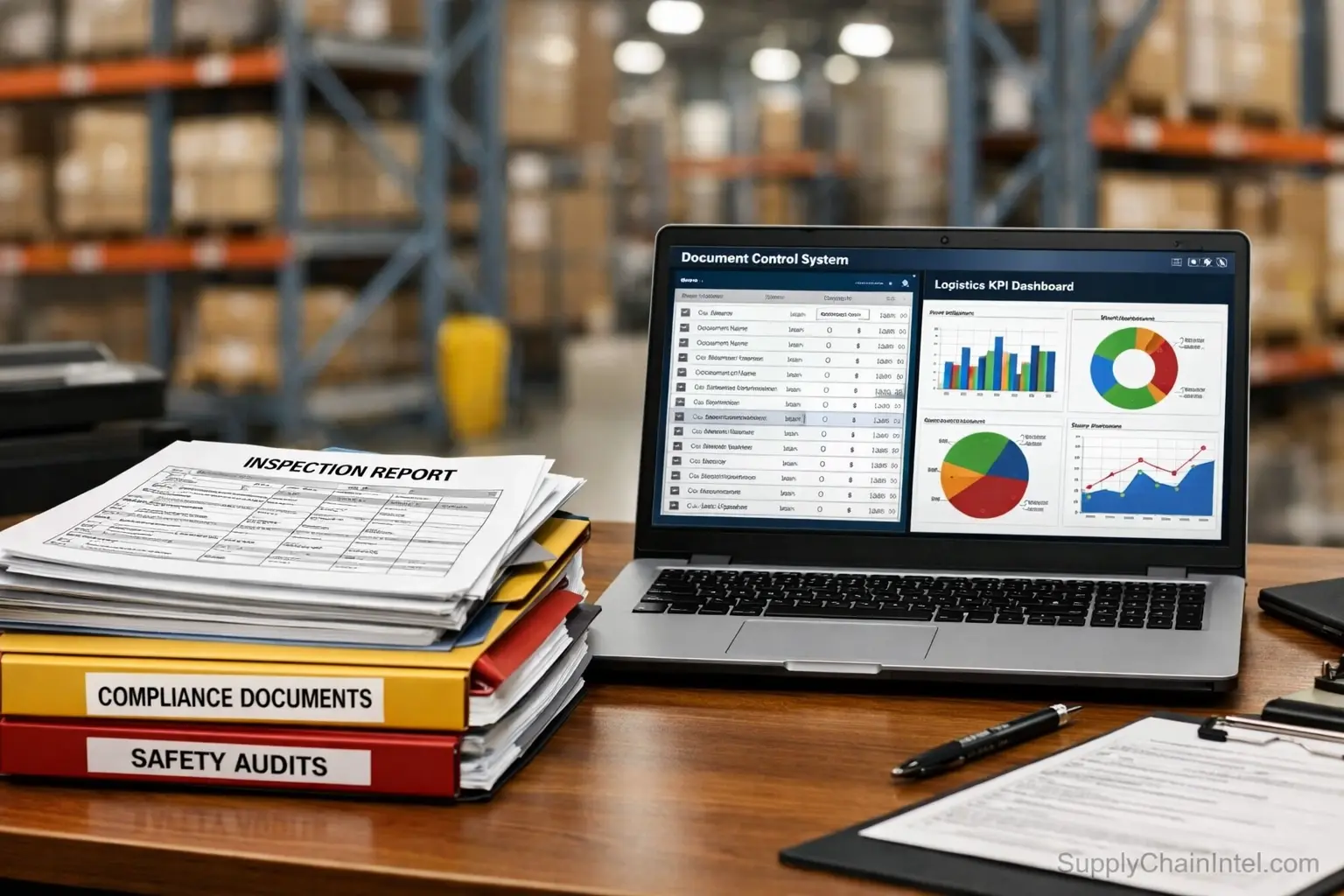
Paper (and digital) trails matter enormously. Receiving logs, shipping manifests, return documentation, chain of custody records for regulated goods — all of it needs to be accessible, organized, and current. Auditors will often ask to see documentation for a specific transaction or time period. If it takes you 20 minutes to find a receiving log from 3 weeks ago, that's a problem.
6. Security and access control
Security audits often fly under the radar in warehouse audit preparation. But for high-value goods, pharmaceutical products, or regulated materials, access controls are critical. This includes functioning CCTV with footage retained per your policy, badge or key-based access to restricted zones, and updated access logs. If former employees still have system access, that's an immediate corrective action.
7. Technology and systems
WMS downtime, data backup failures, or unauthorized user access in your systems can all surface during a compliance audit. Especially for food-grade or pharmaceutical warehouses, system integrity is directly tied to traceability requirements. Ensure your software is up to date, user permissions are current, and backups are tested regularly — not just scheduled. You can also explore more on warehouse systems and analytics.
8. The final walkthrough
The 24 hours before a known audit (and part of your routine for unannounced ones) should include a dedicated walkthrough. Floors clean and dry. Lighting adequate. Loading docks organized. Key staff briefed on the audit scope and their roles. Every document that could be requested already pulled together in one place.
Pro tip: appoint an audit coordinator
Designate one person per shift as the audit point of contact. They know where every document is, can walk an inspector through the facility, and can answer common questions without escalating to management for every item. This one change dramatically reduces audit-day stress.
Sample items
A snapshot of your warehouse audit checklist
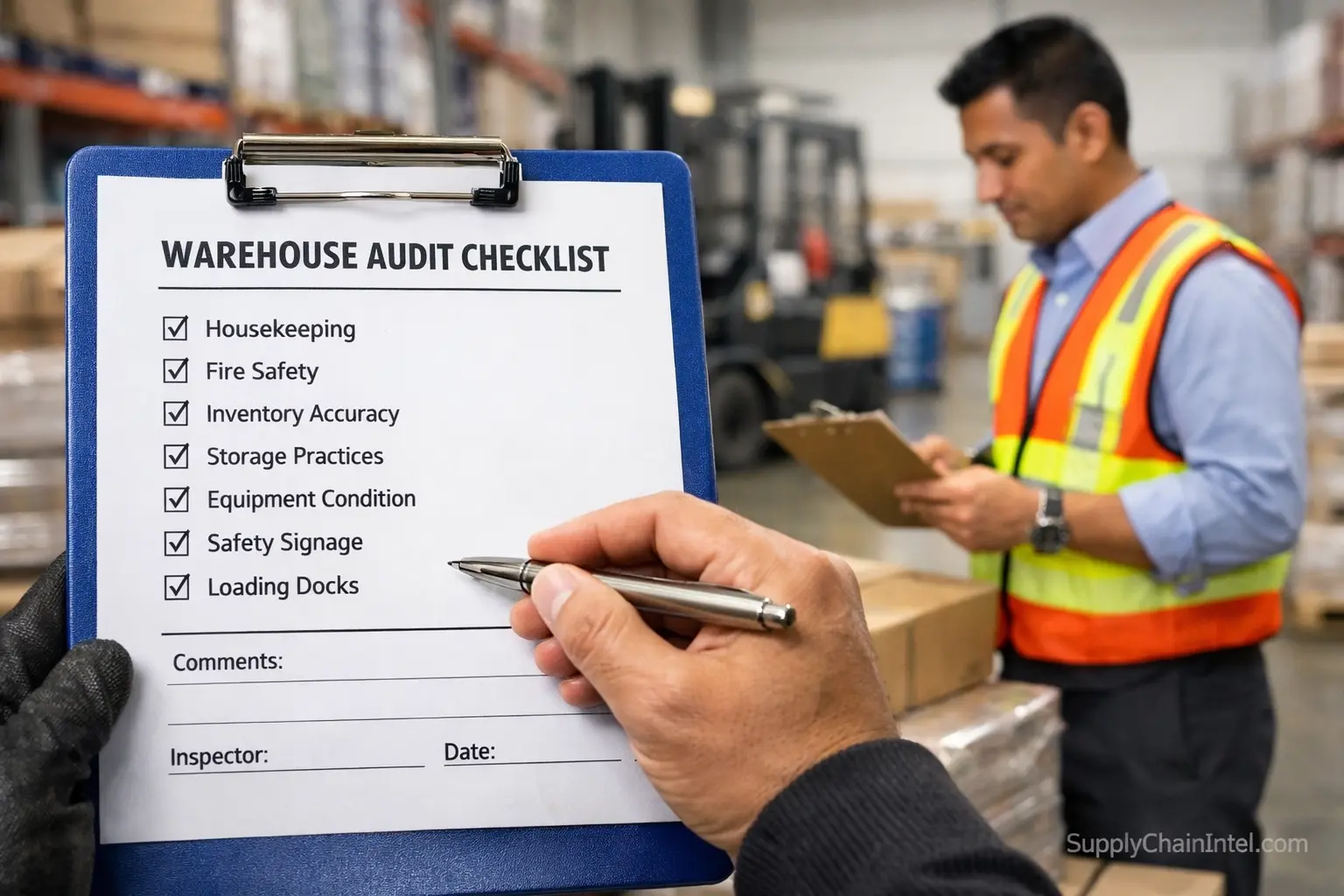
Here's a sample of what a properly structured compliance checklist looks like in practice. The downloadable version below covers all 8 categories with 50+ line items.
Sample checklist items — inventory & safety
Physical inventory count matches WMS/ERP system records
Cycle count schedule is up to date and documented
All safety signage posted and visible (fire exits, PPE zones)
Fire extinguishers are inspected and within service date
Forklift/pallet jack inspection logs are current
Equipment operator certifications are valid and on file
CCTV cameras are operational and footage retained per policy
Receiving logs (PO, BOL, quantity, condition) are complete
Building a routine
Making audit readiness a daily habit, not a fire drill
Here's the hard truth about warehouse audit preparation: if you're scrambling to get ready when an audit is announced, you've already lost. The goal is for your warehouse to be audit-ready on any given Tuesday afternoon — not just the day before inspection.
The way you get there is through cadence. Weekly safety walkthroughs. Monthly inventory reconciliations. Quarterly internal audits using the same checklist your clients or regulators would use. Semi-annual reviews of certifications, licenses, and equipment maintenance schedules.
Assign ownership to each category on your checklist. Not "the warehouse" owns forklift certification tracking — someone specific owns it, and that person is accountable. When you distribute checklist ownership across your leadership team, nothing falls through the cracks.
Post printed checklists at key stations — the dock supervisor's desk, the receiving area, the safety board. When the checklist is visible, it's less likely to be forgotten.
Technology helps too. Modern WMS platforms often include compliance tracking modules. Even a simple shared spreadsheet updated weekly can give your team a live view of what's current and what needs attention before it becomes an audit finding.
When things go wrong
Responding to audit findings like a pro
Even the best-prepared warehouses sometimes receive findings. What separates compliant warehouse operations from struggling ones isn't the absence of findings — it's the quality of the response.
When an auditor issues a corrective action request (CAR), document it immediately. Assign a responsible person, set a realistic but prompt completion date, and follow through with evidence. Auditors return to verify. If your previous CAR documentation shows a pattern of quick, thorough resolution, you'll build credibility that actually reduces scrutiny in future audits.
Never argue with an auditor on-site. If you disagree with a finding, note it professionally and address it through the appropriate appeals or response process. Combative responses consistently make situations worse.
Your takeaway
Start with the checklist, build toward the culture
A warehouse audit checklist is more than a compliance tool — it's a mirror that shows you how your operation really runs. Used consistently, it reveals gaps before auditors do, builds accountability in your team, and creates the kind of documented, traceable operation that earns trust from clients, regulators, and your own leadership.
The warehouses that pass every audit aren't the ones that prepare hardest in the 48 hours before inspection. They're the ones that made readiness part of their standard operating procedure months and years ago.
Download the complete checklist below — 50+ items across 8 categories, print-ready and fully customizable for your facility type and regulatory environment. Fill it out once. Then put it on a recurring calendar. That single action is the difference between a compliance warehouse and a reactive one.
Complete Warehouse Audit Checklist
50+ items · 8 categories · Print-ready Word document
FAQ
What is warehouse audit readiness?
Warehouse audit readiness means maintaining processes, documentation, and operations so the facility is always prepared for inspections, including unannounced audits.
What should a warehouse audit checklist include?
A warehouse audit checklist should include inventory accuracy, safety compliance, equipment maintenance, documentation, access control, and system integrity.
How often should warehouse audits be conducted?
Internal audits are typically conducted monthly or quarterly, along with regular safety inspections and operational reviews.
Why do warehouses fail audits?
Warehouses often fail audits due to poor documentation, inaccurate inventory, expired certifications, weak safety practices, and lack of internal audit processes.
What is the benefit of a warehouse audit checklist?
A warehouse audit checklist helps standardize compliance processes, improve accountability, and ensure readiness for inspections at any time.